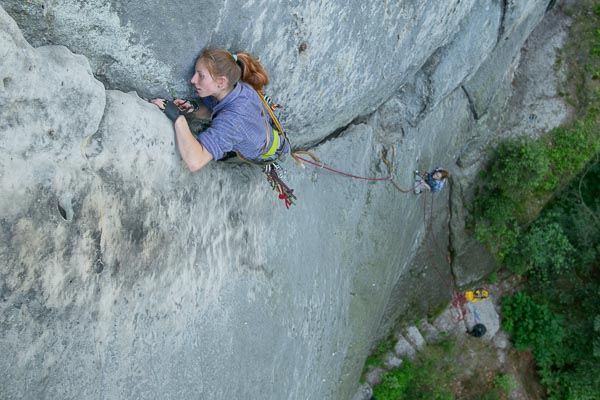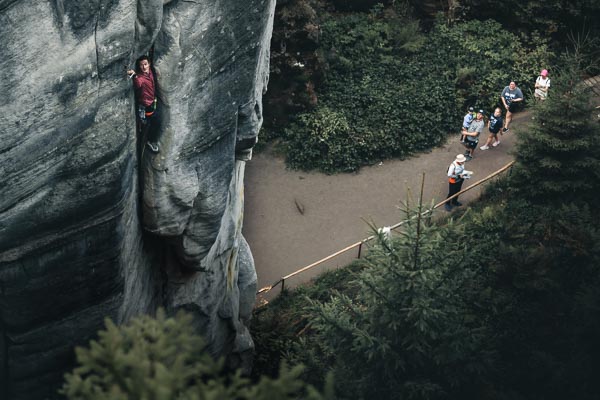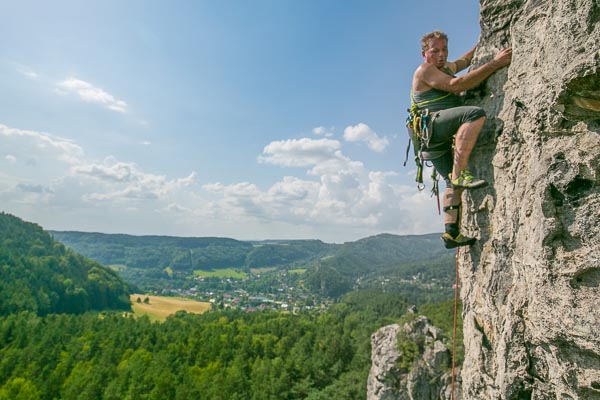
Who’s ever seen 93 girls, at least half of whom are leading on traditional sandstones of Saxony? And all together, no less? It seems times are changing… If you look at the summit logbook of any tower in the Bielatal, you’ll find proof. The entry from April 25, 2026, reads: “241 Gipfel schaffen WIR auch ohne Zipfel.” (We can conquer all the towers even without Zipfel. In spoken German, “Zipfel” is something that hangs between a man’s legs, author’s note).

A similar event took place three years ago, when a group of 21 girls decided to repeat the five-pitch (!) climb on the Kleiner Amboss tower in Saxony. The route is called 1.-April-Weg VIIa. The girls spent the whole day on the route back then, and you can read about it here.

“It was a great feeling of teamwork, and even back then we felt that we definitely had to do something like this again someday,” recalls climber and mountaineer Rosa Windelband (who appeared in the June photo of the 2023 eMontana calendar, author’s note), who was also behind this year’s idea when the girls took over Bielatal near the Czech town of Ostrov.

Roso, whose idea was it to climb all the towers in the Bielatal? And how did you manage to get so many participants together?
To be honest, I don’t even remember who first suggested this area, but I liked the idea right away, and we decided to go for it. I created a simple registration form because we needed to know in advance who was coming and what type of climbing suited each person—who wanted to lead, what difficulty level they preferred, and so on.

First, I shared the form with friends and in existing WhatsApp groups, including the group from the previous route-setting project. I was surprised at how quickly we reached 50 registrations… I had calculated that we’d need at least 50 climbers. With 25 rope teams, each team would have to climb about ten routes during the day, which is doable.

But then more and more interested women started signing up, and in the end, I didn’t even have to promote the project anymore. At one point, I was even worried that too many girls would sign up and that we wouldn’t be able to handle it at all. In the end, though, it turned out perfectly, and 93 climbers participated.

Can you tell us a little more about the organization? What did you do?
I was mainly in charge of the overall oversight and making sure everything fell into place. But from the very beginning, I also really wanted us to create a sense of teamwork within the community. That’s why we set up various working groups, and the girls could sign up for them during registration if they wanted to contribute. It worked incredibly well, and in the end, it truly became a community project.

For example, we had a supply team that planned and purchased all the food for everyone. Another group then cooked right on site. We also had a photography team, people taking care of the cabin where we slept for two nights, and another group organizing the Saturday party so we could celebrate together.

And then there was also the logistics team, which, to be honest, had one of the most complex tasks: coordinating all the climbing requests and preferences the girls submitted during registration, and creating a plan for which teams, in what composition, would climb which peaks. It was a huge task, and this team did an amazing job—in the end, the whole plan worked out perfectly.

So a really big thank you to all the girls who were involved. It was truly a great example of teamwork, and it was amazing to see how many people got involved.

Can you say which towers were the hardest?
That’s actually not so easy to answer. I think every team had its own difficulties and challenges. For me and my team, the hardest tower was definitely Herkuleskopf. We decided to climb a route graded IXa on it (Atlantis, RP IXb, ed. note).

Before that, I was in “summit-collecting” mode and had a lot of other organizational things on my mind, but suddenly I had to switch to total concentration and difficult climbing. In the end, it worked out and it was great.

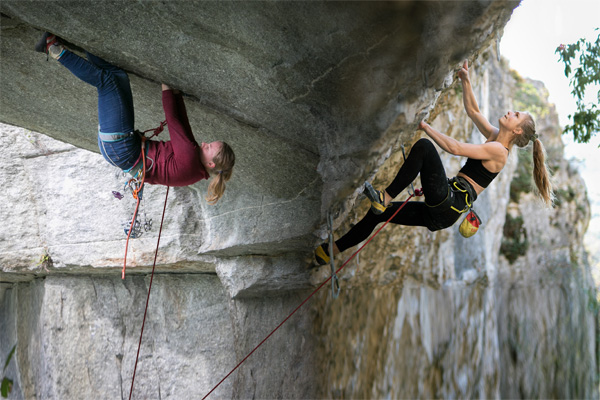
The hardest part for me was switching from “organization mode” to “full climbing focus mode.” Rosa Windelband on the left, Bielatal, April 2026 (photo: RW)

What do you remember most about that day?
For me, it was the feeling that we were working together toward a common goal, and the realization that we’d only succeed if everyone pitched in and did their part.

Throughout the day, we used a group chat where the rule was: whenever a team reached a new peak, they’d post the name of the tower and a selfie from the summit. So my phone was vibrating in my pocket all day, and every time it happened, I knew: ‘Wow, another summit for the collection—another team standing together at the top.’

We also set a rule that there had to be at least two people at the top. We really wanted it to be a team effort. And then, in the afternoon, as I scrolled through the group chat and saw hundreds of selfies with happy faces, everyone working toward the same goal—for me, it was the best feeling imaginable. “Being part of something so much bigger.” And I think a lot of the climbers felt the same way.

What really hit me later—and what made me incredibly happy—was realizing just how inclusive the whole event was. Anyone who wanted to could participate. Experienced climbers, beginners, younger people, older people… Even children and women with disabilities were climbing, and this diversity struck me as something truly exceptional and beautiful.

I also liked how the girls started to overcome their previous “mindset.” Normally, they might only climb as followers, but here we needed lead climbers, so they pulled themselves together and suddenly they were able to lead.

What was the biggest challenge of the day?
The most complicated part of the day was definitely the logistics. We split into 34 teams, ranging from pairs to groups of four. Some teams with children were even larger. There was a really complex planning process beforehand to figure out which sets of peaks could best be climbed together and who would take on which climbs.

We also had one member who served as our “command center,” monitoring the group chat all day and checking off the peaks. This way, someone always had an overview of the whole group. Every now and then, she posted updates in the chat, such as: “You’ve already conquered 100 peaks!” or: “You’re halfway there!” and toward the end, she also prepared a list of the towers that were still missing.

If it turned out during the day that a team was having trouble climbing a particular tower, that team would ask for help in the group chat. “Sorry, we have to bail! It’s too hard… Can someone else climb it?” And usually, another team nearby would respond almost immediately: “Yeah, we’ll take it.” We helped each other out all day long.

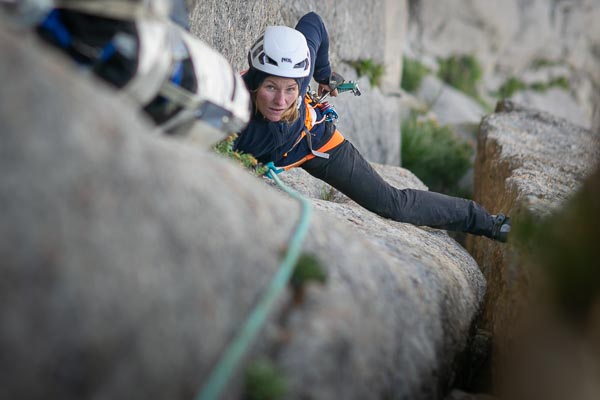
Rosa Windelband climbs SO-Kante VIIb on Grosser Herkulessäule, Bielatal (p: Vallerie Hähnel)

How long did the whole thing take?
In the end, the entire challenge took us eleven hours. Things started to get a little tense toward evening, because one tower deep in the back of the Bielatal turned out to be much harder than we expected. There was even a dramatic fall into a sling. So at 7:30 p.m., the support team at the hut hopped on their bikes to head out and help.

When the message finally came: “We’ve climbed the last tower,” a huge cheer echoed through the hut. (group picture)

Actually, we still had a little time left. I thought we’d have to climb somewhere with headlamps at the very end, but it wasn’t necessary, and we were all able to enjoy the evening together.

Last question: what do you prefer about climbing with guys? And what do you like about climbing in an all-girls group?
I also really enjoy climbing with guys and actually do it more often than climbing in women’s teams. But there are still certain differences, partly due to physical factors, socialization, and also because of the historical development of our sport.

Climbing and mountaineering were the domain of men for a very long time, so that influence is still felt today. A male-oriented approach still tends to prevail, which is why in mixed groups, men often climb the harder routes. Of course, this is a generalization, but it’s something you notice.

For this reason, it naturally happens that the stronger climbers go on the first end of the rope. And women climb on the other end. This can definitely be a positive experience—I also think it’s amazing to second some tough routes. At the same time, however, it’s extremely important to experience climbing on your own: to climb a route by yourself, to decide what you want to do without a guy, and not to rely on a guy taking the lead for you when you’re struggling.

That feeling of confidence when you naturally take the lead is much more present when you’re climbing with people who are at a similar skill level. And for me, that’s often the case in all-female teams. I’ve noticed that when I climb with girls, I’m often able to push myself harder and have more confidence. Partly because the team dynamic is usually very supportive, and partly because there’s simply no option to back down and let a friend finish the climb once things start to feel scary.

Besides that, I’ve often found the group dynamic in women’s climbing teams to be something very special—a very understanding and open environment where I feel comfortable even when talking about my fears and weaknesses. And with this project in Bielatal, that feeling was taken to the next level because so many of us were involved in one big challenge.

It would be great to organize something similar again—we’re already brainstorming ideas, but I think this event will be hard to top.


Sandstone? Mountains? | Follow us on our adventures at eMontana Facebook page