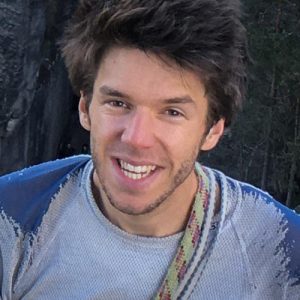

James Pearson
“I try to be at least half as efficient as my wife Caroline. But I don’t think I’ll ever manage that.” One of the world’s best traditional climbers, James Pearson, talks about how he manages to juggle everything with two children whilst still climbing great stuff.
He envisioned and was the first to climb the Bon Voyage 9a route. Or he recorded the first repeat of the Tribe route (unrated, ed.) by Jacopo Larcher. He’s the Pearson of climbing, and there aren’t many better trad climbers in the world. When it’s fully on gear and really tough, his name is almost always in the log-book.
When I first spotted him at the Melloblocco 2026 climbing festival, he didn’t quite fit my image of a ‘stylish pro’. He was wearing old rags and looked more like a bit of a dirtbag – on his hairy legs, he had high, grey, even hairier socks. A scruffy, long-haired Englishman in hiking boots was just trying to squeeze himself and four other mates into a small Fiat Panda. They threw a pile of bouldering mats onto the roof and set off to climb…
A day later, he turned up in slightly more “presentable” clothes and had swapped his hiking boots for approach shoes. We met in the chill-out zone, a short distance from the festival action. In the end, my mate Přéma took charge of recording the interview whilst I took photos. James was honest, authentic and fully engaged with us. After each question, he always took a long time to think before he started speaking. The agreed half-hour stretched to an hour and a quarter. We carried on chatting even after the voice recorder had been switched off.
I was particularly interested in how he manages to balance his career as a professional climber with being a professional parent…
NO MORE BOLD ROUTES. OR?
How has your approach to traditional climbing changed since you became a dad?
Basically, the way I’ve approached bold and dangerous climbing in the past has always been quite calculated. I’ve always wanted to understand all of the possibilities that might happen and make sure I’m controlling as many of them as possible. In that way, I don’t think anything has changed significantly since I became a dad and have two kids.
I expected there would come a moment when I’d say to myself, “enough is enough – no more dangerous routes,” but I’ve actually done some of my most dangerous trad routes after becoming a father. Which might sound awful when you say it that way. (laughs)
In my opinion, my kids have simply become just another part of this equation. Before, I needed to feel X amount of secure on a route to go for it. And now, based on the kids being here, I need to be Y amount secure.
What was the first challenging route you climbed as a parent?
Probably Harder Faster E9 7a. (The difficulty of the moves is around 8b; it’s a harder and more mentally demanding extension of the well-known Gaia E8 6c route in the Peak District, ed.) My daughter Zoellie wasn’t even born yet, and Arthur was about two years old. Twenty years ago, one of my best friends was climbing that route; I watched him and thought to myself: ‘Well, this is a route I’ll never attempt – it’s far too dangerous…’ Well, then, quite unexpectedly, the moment came when I set about it, and by then I was already a dad.
In the meantime, I’d become a well-rounded climber, and rather than learning Harder Faster in a couple of hours, I spent a full five days on it on top rope. On the first day, I climbed it straight away without falling, and then spent the following days on it to get to grips with all the finer details. I also did various odd things – for example, I’d take a five-second pause at every hold… In the middle of the crux, which is objectively quite a hard boulder problem involving really bad slopers, I later managed to let go of both feet and hold on the top sloper with just one hand. I knew at that point I had so much margin on the route, so there was literally almost zero chance of falling. Sure, there’s always a small chance, but I’d probably fall down on my stairs at home and break my neck that morning.
What is your motivation for these kinds of routes?
The ultimate paradox is that climbing dangerous routes doesn’t make any sense. There’s no point in creating artificially dangerous situations just to feel alive, but it’s simply something that’s a part of who I am. It’s basically like a drug, and I’m just trying to find my own way to be okay with that…
So the approach has basically stayed the same. As I’ve gained experience over the course of my life, my level of control has increased as well. Just that the margin for error that I need to feel when I am climbing a dangerous route has increased, so I can feel as close to certain that I won’t fall on the route. Because the last thing I’d ever want to do is leave my kids without a father.
Do you ever feel an inner conflict between your climbing ambitions and your family responsibilities?
Sure, we’ve already covered trad climbing and the paradox that I’m doing something that’s ultimately completely pointless. But what’s even more confusing to me is simply passing the time to go climbing in the first place. I’ll say it again: “Climbing is a fairly pointless activity…”
I climb because it makes me really happy, but I often feel that I could be spending my time doing something more productive with my kids. I could be playing with them in the garden or going on adventures in the woods. And I do those things anyway, but I could always do more.
I keep telling myself that my children are definitely the most important thing in my life, in my entire world. But the way I act doesn’t necessarily always back up that idea because I’m ultimately a selfish human being. I think a lot of us are, we don’t want to admit it.
So I wrestle with that a bit. Climbing fills me with happiness and makes me a reasonable okay person. If I didn’t have climbing in my life, I’d be a much worse person to be around. At least that’s how I justify it to myself. I don’t know if it’s right or wrong, but at the end of the day, you’ve got to find a way to live with yourself, you know?
“Climbing fills me with happiness and makes me a reasonable okay person. If I didn’t have climbing in my life, I’d be a much worse person to be around.”


BETTER CLIMB THAN TRAIN
What role does adventure play in how you raise your kids? Is it important to keep that spirit alive both in childhood and adulthood?
I’m obviously incredibly blessed because I’ve spent my entire life pursuing some sort of adventure. So it’s pretty clear that I greatly value this quality in people. I want my kids to emulate that in some way. It’s not that I want them to be exactly like me, but rather I want to show them how much joy and how many wonderful experiences adventure has brought into my life, so I want my kids to have a chance to experience that too.
I myself gain so much energy simply from being in places like this (Val di Mello, ed.), and I’d say that, especially in today’s digital age, it’s important to show children ways to spend time outdoors, whether it’s climbing or anything else. We’ve decided not to get them mobile phones until they’re sixteen. We don’t have a television at home.
Our children spend most of their free time outdoors – either playing in the garden or in the woods. Arthur is practically self-sufficient when we head out to the crags. He’s capable of playing with sticks or stones all day long and making up his own little adventures. We also teach our children to understand the concept of danger, so that later on they’ll be able to make their own informed decisions about whether a particular danger is acceptable or not. For example, whether they’ll jump off a rock by themselves, or whether we’ll give them a bit of a hand. Sometimes they don’t quite manage it and we shout at them: “No, no, no! Don’t go so close to the edge!” (laughs) This decision-making on their part is essentially similar to what my wife Caroline (Ciavaldini) and I do all the time when we’re climbing traditional, bold routes.

What does your typical week look like when you’re trying to balance work and family life? Is there a typical week at all?
For a start, there’s probably no such thing as a typical week. (he laughs). Our week looks completely different compared to how it was seven years ago, before Arthur was born.
Back then, just the idea of “having kids” and not having less free time for us was something that really terrified me. Now, having children is by far the best thing that’s ever happened to us, even though, objectively speaking, we have much less time for the things we’d wanted to do. Now, climbing feels almost like a gift for us.
So, honestly, my typical week right now involves probably going climbing outside once or twice (if I’m lucky) and basically not training. With such limited time, I prefer just to climb outdoors rather than train, because that’s what I love most of all.
So now you’re training smart rather than hard?
The moment our first child was born, I thought our climbing careers were over. (laughs) At the time, I had a few injuries I just couldn’t shake off. I’d injured my elbow and was also having trouble with a toe. I was struggling to put my climbing shoes on, so I started asking myself: ‘Is this really the end?’ The thought kept running through my head that perhaps the logical time had come to give up climbing, as I’d just become a new dad.
But after a few months, Arthur started sleeping better, I felt a huge surge of motivation, and I started climbing again. When he was six months old, I climbed my second 9a. After a six-year break from routes of that difficulty. And when he was one year old, I climbed my first 8B+ boulder. I managed all this whilst I was completely out of shape and wasn’t expecting anything of myself…
So I started to wonder whether I’d been putting unnecessary pressure on myself for years to perform at my best. Suddenly I felt free and could do whatever I wanted, wherever I wanted… Well, and when I allowed myself to fail and ease off in certain areas, suddenly everything started to fall into place.
After our second child was born, Caro and I started training with Lattice (myself with Ollie Torr and Caro with Maddy Cope). For about two years, I took it very seriously – I pushed myself hard on the training board and in the gym, did fitness training and hardly ever climbed outdoors. The progress was clear – I climbed my first two 8C boulders… I thought to myself: ‘Wow. How far can I push this?’ And then the injuries came.
Then, at a certain point, I realised that the less I train, the more time I have for climbing outdoors. So I sorted it all out in my head again and said to myself: ‘Yeah, this is really what I want to focus on.’ At the same time, I’m still drawing on the foundation I built with Ollie, and every now and then I’ll give it a bit of a boost with a short training cycle.
The days of training hard are long gone, so my answer is: train smart. (laughs) Generally speaking, children force you to be smarter and more efficient in how you manage your time, whether it’s climbing, training or life in general.

THE WEAKER THE BETTER
At what age do you think a traditional climber can reach their peak?
I think there are a few traditional climbers in Britain at the moment whom I’d describe as the best… And they’ll all be turning fifty soon… Climbing is a very complex sport in which you can draw on the hours and years of movement you’ve learnt previously. That helps you later on, when you’re older. This is doubly true in traditional climbing, because there’s also the whole aspect of placing protection, managing fear, efficiency, and so on.
I’m probably no longer at my physical peak, which I reached at around 25, but I’m climbing much better now than ever before, because thanks to my experience I’m able to make better use of my physical capabilities. So I hope my climbing days aren’t numbered.
Before we started this interview, you mentioned you’ve got a new project. Can you tell us more about it, or do you want to keep it to yourself?
No, it’s definitely not a secret – I can! (laughs) After I climbed Bon Voyage, I said:
“Right, that’s enough. I’m done.”
But Caroline said: “Just wait…”
I replied straight away: “No, no, this is good enough. I’ll never be better than I am now.”
But some time has passed since then, and today? I have several big projects that I’m switching between depending on what the conditions feel like.
I have several boulder projects that could probably be the hardest boulders I’ve ever done, and I have a trad project, which feels to me a lot harder than Bon Voyage in terms of its difficulty. At least I’ve already spent a lot more days on it than I spent on Bon Voyage, and I’m not anywhere near making serious RP-attempts.
On the other hand, that route is not my style at all. It’s relatively safe, but quite run-out, so you’re going to take big falls, but you’d be really unlucky to hurt yourself. The crux is the boulder problem right at the very top. First you have to climb about a 35-metre endurance section on good jugs, but very overhanging to get there without being pumped, and this is my worst nightmare.
“I have a trad project, which feels to me a lot harder than Bon Voyage.”
Speaking of training, do you use any time-efficient training hacks?
I don’t know if it’s a time-efficient hack, but I like workouts that don’t take too much time. I’ve always been a fan of short, intense sessions that I’d rather repeat more often and more regularly. When I was younger, I used to do a twenty-minute fingerboard routine every day. I’m still doing that, but maybe once a week right now.
Hmm, I’m hesitant to give any advice, because as soon as any pro-climber says that they do something, everyone starts doing the same. So please – don’t necessarily do what I do because it’s probably really stupid! (he laughs)
I like to try to combine workouts like fingerboarding and a stretching routine by combining exercises that work different parts of the body. I can effectively use the rest time of one to complete the exercise of the other and vice versa. This effectively doubles my efficiency, meaning I can do a reasonable session in about 20 minutes to half an hour.

Is it possible to combine longer climbing trips (mountain expeditions) with family life? Is there anything that’s worked well for you?
I’ll be honest: longer trips are getting more and more challenging as the children grow up. When they’re still little, it’s quite easy and you take them everywhere with you, because they don’t ask you anything. But as soon as they start to realise they have their own needs and can express them in words, it’s hard to remain selfishly focused solely on yourself and on climbing. Especially when they call out to you: ‘Dad, please, can we go home? I’m bored of these rocks now… I want to do something else.’
During the first few years with the kids, we took a few climbing trips to Ticino over the winter, and it was amazing. It was the first time I’d been bouldering in Ticino in almost twenty years, and I was like: “Great, this is going to be what our life looks like for the next ten years!”
And then little by little, we’ve done less and less of that because it is not a fun place for the kids to hang out anymore. Maybe one day they’ll get really psyched on climbing, and we can do it again. But for now, we generally do a lot more climbing around home in France.
Any advice for parents who used to be absolutely passionate about climbing, but then had children? How do you come to terms with it mentally?
My advice is: don’t worry, you’ll get better and stronger again. It worked for me, and it’ll work for you too. I know that every family is different, just as every child is different. You just have to find your own way, but I believe that if it worked for us, it can work for others too.
As time goes on, things get easier with the children, because as they grow, they need less care and less attention. At the same time, you gain more experience, and things that used to terrify you – and might took you two hours to prepare – suddenly aren’t such a big deal. You just throw everything into your rucksack and you’re out the door in ten minutes.
I suppose it’s like life in general – stick with it and you’d get better. No secrets, no surprises… It’s like working on a project – sometimes it feels hard, sometimes you fell you’ll never get to the end… But you know at some point you’ll come back on it, you’ll get better and you’ll probably do it one day.


He was born on 15 December 1985 in Matlock, which is part of Derbyshire in the United Kingdom. Matlock lies close to the Peak District, where James also began climbing on the local, very hard sandstone.
In 2008, on the Devon coast, James climbed a route called The Walk of Life, which he graded at the then-unprecedented difficulty of E12 7a (9a). However, the route was very quickly repeated by Dave MacLeod, who downgraded it to E9 6c (8a+ or 8b), resulting in one of the most famous downgrades in climbing history.
As a result, James became the target of criticism within the climbing community. The full story is captured in the documentary Redemption: The James Pearson Story. Following this incident, James left Britain for several years, moving to Europe to pursue sport climbing and bouldering.
In 2014, he returned to Britain to tackle his unfinished project in Scotland, the route Rhapsody E11 7a (8c+) and he made a fourth ascent of the route. James describes this moment as one of the most important milestones of his climbing comeback.
In 2023, he completed his biggest project to date: Bon Voyage in Annot, France. After much hesitation, he once again graded the route E12 (9a). To James’s great relief, Adam Ondra confirmed this grade with his first repeat.
James lives in France (L’Argentière-la-Bessée) with his wife Caroline Ciavaldini and their two children – Arthur and Zoellie. Together with his wife, he is behind the Once Upon a Climb project, which documents their expeditions, travels around the world and their family life as climbers with their children.

CAROLINE’S PERSPECTIVE
They say that behind every successful man there is a great woman, so we asked Caroline Ciavaldini a few more questions, Ed.
.
How old are your children now, and what is the biggest challenge for you as parents at this age?
Zoellie is four and Arthur is seven. Now that they’re older, the biggest challenge is, of course, organising our time. They’re at an age where they’re starting to develop their own interests, and there are some things they don’t like. It’s no fun for children to go rock climbing with you all the time…
So basically, you have to cut down on the time you spend there. Like all my friends, we’ve specialised in micro-sessions. You turn up at the crags, but you’ve only got time for three or four routes, so you warm up beforehand, and once you’re there, there’s no time to rest – you just climb, you don’t dawdle, you don’t stop.
What’s your biggest climbing project at the moment?
I’ve got a few bouldering projects and a few things on the rope as well, but nothing too difficult. This summer I climbed a few 8A boulders in Rocklands and picked up a few injuries in the process. I’m 41, so I suppose that’s quite normal, but of course it’s no fun. I’m also well aware that as I get older, it’ll become increasingly difficult to avoid injuries.
I had a torn ligament throughout the autumn and winter, so I didn’t do much bouldering until the summer. I’ve definitely got plenty of strength, but of course the injury cost me all my endurance, which I’m now trying to build back up.
I’m working on a few sport routes, but nothing too ambitious. I’m just trying to get back into shape. Steve McClure once told us: “It’s hard to stay in shape when your body isn’t working as well as it used to…”
What are your plans for your next family climbing trip?
I’m not sure if you can call it a family climbing trip, but we’ll be heading to the festival in Valle dell’Orco soon. (It takes place from 24 to 27 September, ed.) We’re also thinking of heading off to one of the Nordic countries next summer for some traditional climbing. We’ll see…
__________