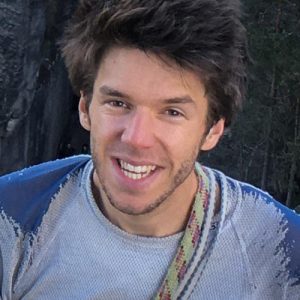

ADVENTURE ON "NORBU DUK LAM", 8a+, 560 m
Thousands of metres above sea level, hundreds of metres of vertical climb. Weeks of preparation, months of dreaming, and yet in the end it all comes down to a few crucial moves. This time, however, it went brilliantly. Jeliga’s brothers have climbed one of the toughest big-wall routes in the Himalayas.
CRAZY TOP OUT
Almost topping out. All that remained was a grade 7, a French 6b, which separated the brothers from the final three easy pitches to the summit… But it didn’t look anything like a grade 7, and above them they could see a ten-metre traverse off to the side where there was nowhere to place protection. Which way exactly should they climb? It was clear that the topo was wrong. “I’d probably just give it a miss,” mused Honza “JJ” Jeliga, who’d been working on this pitch for over an hour, climbing a bit each time only to come back down. A tenth desperate glance at the topo… “What on earth is this?”
Marek “Marin” Jeliga suggested his brother traverse 50 metres to the right towards the edge… “You’ve gone mad, haven’t you?” Then the guys realised there was probably no other way, and Marin carried on straight up… “It took massive determination – from the start, you don’t know if you’re climbing in the right direction,” explains Marin. “It was an adventure, perhaps too much so. Crumbly, rumbling rock that you’re holding onto whilst simultaneously having to place your protection into it…”
The brothers managed the crumbly and dangerous final section of the route, and an hour after dark, two lights came on at the summit of Little Jamyang Ri in northern India (5,600 m above sea level). We watched them anxiously from base camp, got in touch via walkie-talkies and discussed their return to the start of the abseil. At a quarter to four in the morning, we were then happily reunited at BC – cold dinner had been left ready on the large dining boulder.

In July, a team of Czech Young Alpinists set off for the Indian Himalayas – specifically, the group that worked together between 2024 and 2026. Marin Jeliga was originally due to climb with Honza Vopat on this trip – but Honza had to pull out of the expedition, so Marin immediately turned to his brother Honza, with whom he had already climbed several major routes in the Dolomites and the Western Alps. They are a well-coordinated pair, and not just when it comes to climbing.
In India, the brothers managed to make the first free ascent of the 18-pitch route Norbu Duk Lam (topo) by the South Tyrolean pair Markus Ranalter and Elisabeth “Lisi” Lardschneider. On this half-kilometre-long wall, as well as facing the fear of brittle rock, climbers also enjoy beautiful boulder sections: the brothers graded two key pitches at 8a+, a grade also suggested by the first ascenders themselves. As a result, the Czech duo managed to climb one of the hardest free-climbed multi-pitch routes at this altitude.
The rest of team also managed other ascents during this year’s expedition and opened up new routes – you can find the full report here. We had our base camp in the Rangtik Tokpo valley at an altitude of just over 4,900 metres above sea level. From an administrative point of view, the Zanskar region falls under the Indian Union Territory of Ladakh; however, the 14,000 local inhabitants tend to regard themselves as one large, extended family, where everyone knows one another. Buddhism is the dominant religion here, and there are around 16 monasteries operating in the vicinity of the Zanskar River.


PRECIOUS VARIATION
Back to the mountains. The following conversation took place the very next day after Honza and Marin returned from the mountain, so it contains fresh impressions from a trip that puts a climber through their paces in every possible way. We’re sitting outside on stone benches in front of the kitchen tent; the Asian sun has been beating down since morning, and we’re going over the events of the past few days.
Could you describe the nature of the rock a bit? Was it mainly cracks, wall climbing, or loose blocks?
Marin: A bit of everything. That’s probably why it’s called Norbu Duk Lam, which means ‘A Very Precious Line’. (laughs) It starts with two pitches of scree, followed by a nice crack with a boulder at the end… Immediately after that, there are two superb sport pitches on compact rock…
JJ: Then it’s a sort of pseudo-crack climb. You follow a long diagonal fissure where you occasionally use a hand-jam, but the rock tends to form these odd steps – sometimes you’re using slopers, sometimes it’s a bit of scree… Towards the end, there are two pitches with lovely crack climbing. One is half a crack and the other is entirely a crack, and that one was really lovely. Towards the top, it’s a mix again: partly loose rock, a crack, a corner, loose rock, a small compact wall…
Marin: It was often quite ‘3D’ climbing in the corners, where you had to come up with creative moves.
What traces of the first ascenders did you come across?
Marin: Occasionally a bolt or piton at the belay stations. We found only five route bolts on the entire wall. About half of the belay stations were set using our own protection.
JJ: There wasn’t much left on the second half of the wall, so it was essentially a very traditional route. Fortunately, we didn’t need any of our own pitons, which was good, because we’ve never actually used them and we’re not really keen on placing them either. (laughs)

What was the section that the first ascenders referred to as ‘crack A1’ on the fifth pitch?
JJ: We aid climbed it in the style of: ‘piton, nut, piton, nut…’ That crack probably can’t be free-climbed at all – there are absolutely no footholds and your fingers won’t fit into the crack.
Marin: So I tried to free-climb around that crack from the right, and it eventually turned out to be a fully-fledged 8a+ variant that connects to the next belay. We drilled this pitch ourselves, and I think I liked it best of all.
JJ: We placed three bolts in our new variant – we drilled them whilst abseiling. In this case, we did it deliberately, because if we’d placed them from below, we’d have needed more of them. (The brothers drilled the bolts by hand without an electric drill, which is the current ethical standard for this valley, author’s note.)
What did you eat during the two-day push?
Marin: Nothing. (laughs)
JJ: On that first day, it was still more or less manageable. Marin kept forcing those energy bars in us. But before the eighth pitch, I was so knackered that I had one of those 50-gram sugar cubes we’d bought in Leh. I ate the whole thing and then climbed that pitch. (laughs)
Marin: But you still looked completely knackered. I’d also like to mention that Miki (Konečný) gave us some dried mango to take up the wall with us. And that was an absolute lifesaver. When you need it, you have a slice and you’re back on top form. Next time, I’m taking mango with me again!
Did you get a good night’s sleep on the portaledge?
Marin: I was upside down, mind you, but I actually got a decent night’s sleep.
JJ: I hardly slept at all. My shoulder was aching from one move on the route; I just couldn’t seem to get myself into that bed properly, and I’m not much of a sleeper to begin with. I kept tossing and turning like a chicken on a spit and didn’t get much out of it. (laughs)


HOME AT FIVE THOUSANDS
How did you find breathing whilst climbing at an altitude of around 5,500 metres above sea level?
JJ: When you can’t stand on your feet and have to do something with your hands, you really notice it. For example, in a crack where you’re working and bracing your whole body, you get quite out of breath. On the other hand, on easier pitches, as long as you’re not sprinting, it’s not that bad.
Marin: I was quite out of breath. Especially at the top, where I was trying to run. And in the dark, too. It felt to me as though I was getting just as out of breath on a 7a+ as on an 8a+.
What surprised you most about the climb?
Marin: I think we were both surprised that we managed to free climb the route in the end. We’d been hoping for it a bit, but on a wall this big, there’s a good chance you’ll come across a two-metre stretch of rock where there’s simply nothing to hold onto and which will stop you.
JJ: My preparation back home wasn’t as good as Marin’s, so I was actually surprised by how many ait pitches there were. (laughs) I’d expected there’d be one 8a+ and that’d be it. But it turned out there were far more uncertainties and far more work involved. We also found that whenever we’d say to each other, ‘Right, here’s an easy pitch, we’ll nail this in no time,’ there’d be some proper nightmare section that took us by surprise. (laughs)
Marin: I’d also like to mention that, at just the right moment, we were blessed with brilliant weather, which lasted exactly the two days we needed for the attempt. Up until then, we’d always been freezing on the wall… The forecast came true and suddenly it all worked out.
As for the grading of those two hardest pitches… Did you take the view that if you were to cut the rock out and move both pitches to, say, Siurana, they’d still hold up there?
Marin: Yes, that’s exactly how we approach it. We didn’t factor in the altitude, which makes the climbing feel harder, when determining the grades. We tried to imagine how difficult those moves would be, say, in the Frankenjura or Spain.
JJ: I think that’s the right way to do it, because otherwise you’d have to grade it based on how well you’d acclimatised… Otherwise, given the nature of those crux pitches, we’re thinking more along the lines of Adršpach or Elbe Valley. It’s that sort of technical climbing, on a gentle slope. Rounded holds. A similar style to climbing on sandstone. Fine-tuning and the occasional power move.
So at least sandstone Xc?
Marin: Something like that. Xc or XIa. I’ve never come across a rock profile like this in mountainous terrain before. Here you’re climbing entirely on friction and just trusting that you won’t slip…
JJ: Yeah, I agree, I think it’s best to compare it to sandstone. We’re familiar with that and can gauge it.
“We did not include the factor of altitude – which makes climbing feel more difficult – in the classification. We tried to imagine how difficult those pitches would be, for example, in the Frankenjura, Spain or on sandstone”


Could you describe the situation right at the top?
JJ: We’d somehow thought that in the second half we’d be running up the easier pitches. So we didn’t get off to a particularly quick start in the morning – we were still packing up the portaledge… It took a while to get the jumars set up; we spent a bit of time looking for the route, and suddenly it was getting dark on the summit ridge. And we’d only brought one head torch with us.
Marin: My head torch. You left yours in the haul bag lower in the wall, saying ‘we won’t need it’. (laughs)
JJ: Unfortunately, we took yours, which ran out of battery after just a short while. (laughs) From the top, we then got in touch with BC via the walkie-talkies to get a bit of guidance – part of the team was already at the summit… We abseiled down one gully into the snow, which took us to the next abseil point.
Marin: I used my phone as a torch by putting it in the pocket of my gore-tex jacket, zipping it up tight, and it always worked for about two minutes before the phone slid back into the pocket and it went dark again.
JJ: The worst abseil was then down to the start of our fixed ropes: into an overhang and out to the side. So I was pushing off and needed to place a couple of friends to get out to the side. But by that time my headlamp was only shining red and would only last 10 seconds before switching off, so it was a right pain trying to find the right sizes of cams by colour. In the end, I used my mobile phone as a torch, swung my way back to our fixed rope and simply pulled myself up. It wasn’t exactly methodical, but luckily nobody saw it. (laughs)

What will you remember most of all?
Marin: I’d never led a pitch as the first ascentionist before, so I was delighted to find a route option there and manage to get round a section that initially looked completely impossible. That really motivated us to try and free climb the whole thing. You don’t come across a pitch as lovely as that very often.
JJ: I really liked how Marin sent both the difficult pitches on his first attempt during the final push. That was brilliant.
Marin: I’d also like to add that I really enjoyed cleaning the route and throwing huge boulders down into the valley. When I was little, I was completely obsessed with firecrackers – I used to plan to make my own explosives… And here it makes exactly the same sound – it’s monumental… It falls for a few seconds and then BOOM! The snow gets blown right up the arse… Or when we were clearing the abseil line at the top, we knocked a massive boulder loose, which sparked as it fell, and you could smell the scent of burnt quartz. I really enjoyed that. (laughs)
Is it the hardest multi-pitch route you’ve ever climbed?
JJ: Definitely. I’ve never climbed a harder one. We really had to work our arses off on it. It wasn’t as if you just turned up to a ready-made route… There were constant surprises here. The conditions weren’t ideal, but we gradually overcame them.
Marin: I’ve never climbed a harder multi-pitch route either. I really appreciate it, partly because of how high up it was. On top of that, I felt absolutely rubbish the whole time – for the first 10 days I had a headache and was popping one paracetamol after another… On the first day of the push, I didn’t feel well either and thought I was going to fall asleep at any moment. In the end, the caffeine-filled ‘chimpanzee bars’ helped.
What do you recommend as the main ‘doping’ for climbers?
Marin: Loads of dried mango! (laughs)


THANKS, LISI
It is certainly worth mentioning the two climbers who were behind the very creation of this route… When Markus Ranalter and Elisabeth ‘Lisi’ Lardschneider, together with their expedition, arrived at base camp in July 2023, a surprise awaited them. It had been snowing heavily for three days, avalanches were coming down from the surrounding hills, and it didn’t look much like climbing weather. They couldn’t even see the mountains. Moving around the valley was quite dangerous, so the north face of Little Jamyang Ri was essentially their only option.
It is so steep that snow does not stick to it, and the approach from BC is via a gentle glacier, so there was no risk of being buried by an avalanche. They climbed the route from 12 to 21 July and set up their portaledge at the end of the seventh pitch. They ate their soup with an ice screw because they’d forgotten their spoons at BC. Their free ascent was halted at the fourth pitch. “With great effort, we placed four bolts using a hand drill, but even after several attempts we still couldn’t manage to climb the pitch,” recalled Markus Ranalter. In their guidebook, they rated the pitch 8a+, which the brothers confirmed this year after their ascent.
In any case, with a bit of hooking, the pair from the Dolomites managed to complete the route, which cuts across an exceptionally compact and vertical wall. You don’t see that very often in the Himalayas. “It must have been quite difficult for them, because over a large part of the wall you can’t follow any clear line. It’s all twists and turns, changes of direction… What’s more, they managed to place most of the belays on some sort of ledge, however small,” says Honza Jeliga, praising them.
However, the 2023 South Tyrolean expedition ended on a very sad note. During the final days, some of the climbers set out on a mixed route up Chanrasrik Ri (6,080 m). The ascent of this mountain begins with a steep firn field, where Lisi slipped and was killed instantly after a 150-metre fall. We honour the memory of this talented young climber, who climbed her first 8b at the age of 14. She was 20 years old during the expedition.


Location: Little Jamyang Ri (5,600 m above sea level), Rangtik Tokpo, Zanskar, India
First ascent: Markus Ranalter and Elisabeth ‘Lisi’ Lardschneider, 12–21 July 2023
Length: approx. 560 m of climbing, 18 pitches
(sketched topo, topo in photo)
Protection: Own gear + pitons and newly driven bolts. Ten bolts from the first ascenders; Jeliga brothers added five (one to reinforce the fourth belay station, three for their own variation and one on the portaledge).
Difficulty: Two pitches rated 8a+
Equipment: Double set of friends from #00 to #4, set of nuts
Ropes used: 9 mm single, 8.1 mm haul rope, three 9 mm static ropes, all 60 metres
Ascent style: Climbed as a team PP (effectively RP, apart from three clipped quickdraws on the entire route), ‘ground up’ style over two days (16–17 July 2026). The ascent was preceded by five days of preparation and work on the wall.
__________
You are reading the final article from the concluding expedition of the Sokolíci 2024–2026 programme, a team of young mountaineers from the Czech Mountaineering Association (ČHS). The main partner of the project is Mountain Equipment. Over the course of these three years, the Sokolíci have been supported by Tendon, Wild Country and Chimpanzee. A big thank you also goes to the family-run travel agency Skitpo Travel for their exceptional assistance during the expedition.
__________