
Retirement’s great! ‘Schusterweg’ III on Falkenstein
From a distance, from the north, it looks forbidding. From the south, it appears enormous – and even higher still. Yet, more than 130 years ago, a group of pioneers managed to find their free climb to the summit of Falkenstein in the Elbe Sandstones. Even today, it is a climb that will delight climbers of any generation…
BEFORE THE TITANIC
Back in the days of men in hats, when people travelled to America on transatlantic steamers and only a few government offices and the wealthiest factories owned a telephone, it must have been a real cracker. Back then, even the pioneering climbers hadn’t yet discovered the trick of using a ring – Rudolf Fehrmann and Oliver Perry-Smith were the first to hammer one in only about ten years later…
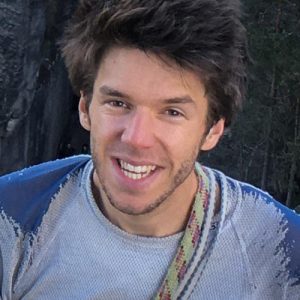
The thing is, this route is still a “real cracker” even in 2026. It’s the perfect way to warm up on autumnal, bleak days like these, as Pavel Krupka and Danka Kadlecová attested when we filmed them tackling this Saxon classic on Falkenstein at the end of last winter. “I’ve actually never climbed it in normal weather. The first time was on Christmas Eve, solo, and there was snow and ice on it,” recalls Pavel, who, at 76, is almost always out on the rocks. And by the way, he’s one of only four Czechs to have climbed all the Saxon towers (1,135 in total, ed.).
Do you recognise the “familiar spots” in the video of this route, which is nearly 150 metres long? Or have you not yet had any personal experience with this “adults’ climbing frame”? Either way, enjoy our new video…
How is „Schusterweg“ on Falkenstein?
– Pavel Krupka and Danka Kadlecová climbs –
OSCAR THE FOREFATHER
A historical insight by Pavel Krupka
Oscar Schuster was born in 1873 in Markneukirchen. Shortly afterwards, his parents moved to Dresden, where he lived for most of his life. He began his secondary school education in Dresden, but as he was frail, his parents sent him to a sanatorium in Switzerland. There, at the age of 14, he discovered the world of mountains and mountaineering, and during his stay in Switzerland, which lasted several years, he climbed a number of four-thousand-metre peaks in the Swiss and Austrian Alps (the Matterhorn, Monte Rosa, Ortler, Königspitze).
As can be seen, the claim that he was frail does not sit well with his mountaineering activities. After returning to Dresden, he passed his school-leaving examination in 1894 and subsequently studied at several universities, obtaining his Doctor of Medicine degree in 1901, at the age of 28. Although it is widely stated that he was a doctor, he did not, in fact, practise medicine. He spent his entire life in the mountains and on the rocks, as he had wealthy parents who supported him financially.
Upon his return to Dresden, he put his climbing experience to good use in Saxon Switzerland. In Saxony at that time, climbing was mainly about ‘conquering towers’, often with the aid of carved steps and holds, as well as various wooden ladders. Oscar Schuster can be described as one of the pioneers of climbing without these artificial aids, and all his routes were climbed free.
He also brought back from Switzerland the first climbing shoes with hemp soles, which made it possible to tackle even the most challenging sections. The first tower he climbed was the Schusterturm (a route rated II) in the Bielatal in 1891, when he was 18 years old. According to his memoirs, he made another ascent of this tower in November 1893, with the aim of placing a summit logbook in a tin box. He was thus also the first to introduce the practice of placing summit logbooks on rocky peaks. In his memoirs, he describes how arduous this second ascent was, as the rock was covered in half a centimetre of fresh snow.
His best-known and most famous route is the Schusterweg on Falkenstein (III), which he climbed in September 1892. He most often climbed with the Meurer brothers and Martin Klimmer. His climbing activities in Saxon Switzerland spanned the years 1891 to 1901. During this period, he made 45 first ascents, 23 of which were on previously unclimbed peaks. Among his best-known ascents are the climbs of both Osterturms (III) and the Meurerturm (IV) in the Schrammsteine.
“Oscar Schuster was the first to come up with the idea of placing summit books on the towers. (1893)”
Schuster’s most difficult route on sandstone is probably to be found in the Grosser Zschand: the Alter Weg on the Grosser Spitzes Horn. Grade V with aid (human pyramid), grade VI without aid. From my own experience, I can say that a crack this wide, smooth, strenuous and unprotected is difficult to climb even today.
After 1901, he devoted himself to climbing and travelling in the mountains, and during this period he completed a total of 725 (!) ascents in the Alps, Norway and the Caucasus. His most significant achievement was the first ascent of South Ushba in the Caucasus in 1903. (This ascent by the German expedition was an absolute sensation at the time. Even today, the route is rated 5B on the Russian scale, editor’s note.) However, Schuster’s final visit to the Caucasus proved to be his undoing. At that time, the First World War broke out and, as a member of an enemy nation, he was placed in an internment camp. There, under circumstances that remain unclear, he reportedly died of typhus in 1917.
His enduring legacy lies in the promotion of free climbing and the rejection of artificial aids; he thus established a further trend in climbing in Saxon Switzerland and on sandstone formations in general.
(This rejection of artificial aids does not correspond with the description of the Schusterweg on Falkenstein in the 2002 climbing guide. It states that, after climbing the first pitch, the first ascenders continued along the sandstone ledge to the right until the very end, where they scaled the vertical, smooth rock face with the aid of a ladder to reach the start of the sloping chimney. This bears absolutely no resemblance to the actual situation. At the very end of that sandstone ledge is a wall about 20 metres high, up which runs a route graded VII, which does not end at the start of the sloping chimney, but at its end… In any case, according to the guidebook, they repeated the ascent six months later as the Klimmervariante, and on that occasion they did not use the ladder, author’s note).


THE DUO AFTER SCHUSTER
The famous duo of Rudolf Fehrmann and Oliver Perry-Smith built on the foundations laid by Schuster. They probably never met Schuster on the crags, as both only began climbing in 1904, at a time when Schuster was devoting himself solely to mountain climbing. Fehrmann was a lawyer by profession and published the first mountaineering guide to Saxon Switzerland. However, it was Oscar Schuster who was the first to publish details of climbing in Saxony in a magazine, and Fehrmann therefore more or less built on the information in Schuster’s article.
Oliver Perry-Smith was an American whose parents sent him to study in Dresden. During his stay between 1902 and 1914, he and Fehrmann established an incredible number of routes that are still considered extremely daring today, reaching a difficulty equivalent to today’s VIIc – for example, the Alter Weg on the Teufelsturm. Smith returned to the USA, where, as I have discovered, he continued climbing on sandstone in Utah and Colorado. He died in the 1960s.
The later life of Rudolf Fehrmann is somewhat less well documented, and his fate bears a certain resemblance to that of Oscar Schuster. Fehrmann became very actively involved in the NSDAP and, as a military judge, sentenced deserters to death during the war. After the war, he was captured by the Soviet secret police, sent to a concentration camp and died there in 1948 under circumstances that remain unclear.
(Perry-Smith and Fehrmann also visited the Dolomites, where they completed a very fine climb on Campanile Basso in Brenta. Although Perry is said to have led the climb, it is named the Fehrmann route V+, 415 m. I have climbed it myself and it is a magnificent corner-crack, author’s note.)


A MEMORY OF DAN PODRÁSKÝ
I wander through the woods, asking people.
I can’t find it at all. In the end, I nearly bump into Falk.
Did that really take four hours?! I’d imagined the Schusterweg to be just as straightforward. ‘It’s an old route, so it’ll be well-trodden. And there’s that bust, isn’t it? I’ll find it.’ Hmm. I walk round the whole thing a few times. That’s another trek… I don’t even like the terrain above me very much, but I’ll try climbing this way, perhaps… Mistake. Whilst climbing down what’s probably the third route, I’m already tempted to give up. I’m taking quite a risk. I’m scrambling around some rings… Why?! I’m supposed to be climbing a grade III! That’s enough. Right, just a few more metres and I’m back on the ground; it turned out well, I’m heading home.
“Schusterweg, do you want, ja?” A German who’s suddenly appeared explains to me how it all works and what I’m supposed to do. Things are moving fast now; I’ve got to get up there. But once I’m guided onto the right route, my memories fade. I only remember the dilemma of whether to climb in climbing shoes, and one move that bothered me. I also have a vague recollection of the descent afterwards, as I didn’t want to deal with abseiling for social reasons and because of the time.
Editor’s note: If you also have any fond memories or funny stories from climbing ‘Schuster’, feel free to write them down and send them to info@emontana.cz. We’d be happy to include them in the article or publish them in “Quickdraws”.
.
.

Thank you for your contribution to the eM editorial team for next year.
It is partly thanks to you that more ‘Lines and their Stories’ can be created. We really appreciate it.
_______________________________